
Key Takeaways:
- Demo throughput misleads; average output across a full shift predicts real performance.
- Self-correction is the true differentiator: recovering from failed picks without intervention.
- Integration with goods-to-person, conveyors, and WMS matters more than robot count.
- Modularity and hybrid picking let operations scale and stay running during disruptions.
Warehousing and logistics ranked as the top segment for professional service robots in 2024, with more than 102,900 units sold, a 14% increase over the prior year, according to the International Federation of Robotics. More options are crowding the market, and vendor selection has become harder as a result. The criteria most vendors lead with during an evaluation—demo throughput, arm speed, and robot count—rarely match the criteria that determine whether a robotic picking system actually performs under real operating conditions. Sound material handling decisions start by separating the two.
This guide covers what to evaluate: the throughput numbers that matter, the integration requirements that drive real-world performance, the machine learning capabilities worth verifying, and the questions that separate vendors with proven deployments from vendors with impressive demos.
Start with Throughput, Not the Demo
The throughput number that matters is not what a robotic picking system achieves during a vendor demonstration. It reflects what that system delivers across a full operational shift, under real SKU diversity, at actual order volume. Most vendors present peak throughput under ideal conditions.
The more useful figure is the average throughput over a full day, including the moments when items become irregular, totes sit partially full, or the order mix shifts without warning. Those moments expose the meaningful differences between systems. A vendor that reports only a single headline figure leaves the hardest part of the operating day undocumented, and that gap tends to surface after deployment rather than before it.
Any warehouse picking robot with real-world deployments can provide throughput data from live operations rather than controlled test environments. A vendor who cannot produce that data lacks the deployment history to back the claims.
Simulation data offers a reliable alternative when live deployment history is unavailable. A well-run simulation models throughput across a full shift, accounting for SKU diversity, order mix variation, and operational constraints before a system goes live. Throughput variance matters more than throughput peaks for fashion logistics and consumer goods logistics operations specifically. A system that runs well on fast-moving, uniform items but slows on irregular SKUs was never sized for the reality of those operations. Current robotic picking trends reinforce the point: proven performance data, not demo-floor figures, separates capable systems from the rest.
Machine Learning Capabilities Worth Verifying in Fashion Logistics and Consumer Goods Logistics
Robotic picking systems have advanced well beyond the rigid, first-generation models that dominated early warehouse automation, evolving into dynamic solutions powered by AI, machine learning, and advanced computer vision. Understanding what that evolution enables becomes the starting point for any serious evaluation.
Modern systems use computer vision to read item dimensions and adjust grip dynamically based on weight, material, and shape. That capability has grown relatively common. What varies significantly between systems is the response when a pick fails.
Self-correction stands out as the meaningful differentiator: whether the system recovers from a failed pick without human intervention, and whether it logs that recovery, learns from it, and reflects it in improved performance over time. Vendors should walk through exactly what failure recovery looks like and how the machine learning loop operates in a live deployment, not in a product overview.
Emulation software belongs in any serious evaluation as a related capability. Operations should run system commands in a digital replica of the real environment before a robotic picking system goes live, verifying that the robots synchronize correctly with sortation equipment and conveyors. The digital twin approach to warehouses documents how this kind of virtual validation surfaces synchronization problems early. Discovering those problems at go-live runs expensive. Discovering them in emulation beforehand does not.
How a Robotic Picking System Integrates with the Rest of the Operation
A picking robot that performs well in isolation while creating friction downstream becomes a net negative for throughput. The integration questions—how the system connects to goods-to-person infrastructure, conveyor and sortation equipment, and warehouse management software—determine whether most implementations succeed or fail. Buyers tend to ask them too late in the vendor evaluation process.
The robot needs to receive totes, signal readiness, and flag exceptions on the goods-to-person side without creating upstream bottlenecks. Misroutes and equipment damage at go-live stem directly from inadequate pre-deployment integration testing on the conveyor and sortation sides, which emulation software prevents.
These systems increasingly operate beyond the pick zone. At packing stations, the same robotic arm technology places items into boxes, wraps them, and prepares orders for outbound delivery, which pushes integration requirements further into the fulfillment flow than many buyers account for in an initial evaluation. Both functions should be tested in emulation before going live when a system handles picking and packing. Industry coverage of how robotics keep pace with competition underscores that integration depth, not raw robot count, drives sustained performance.
Temperature zone compatibility is a concrete integration requirement that buyers can overlook easily. The system's grippers need a rating for sub-zero environments for operations running in chilled and frozen zones, and the vendor should be able to demonstrate deployments in temperature-controlled facilities rather than ambient warehouses alone.
Warehouse management software drives the picking logic, so integration with that system needs testing and support rather than assumption. Confirm that the vendor follows a documented integration process and has executed it in operations similar to the buyer's. A reference deployment in a comparable facility tells far more than a specification sheet, because it shows the integration holding up under live conditions rather than on paper.
What Modularity Actually Means for the Operation
The ability to add robots to a fleet incrementally, without redesigning the system architecture, delivers more value than raw throughput at full deployment for operations with seasonal peaks or growing order volumes. A system that demands a complete reconfiguration to scale was never built for how most fulfillment operations actually grow.
Hybrid operation capability matters for the same reason. Being able to run automated and manual picking in the same environment preserves continuity during maintenance windows, volume spikes, and transition periods. Operations relying solely on automated robotic picking can end up fully offline when robotic arm maintenance is required or order volumes overwhelm the robotic picking rates.
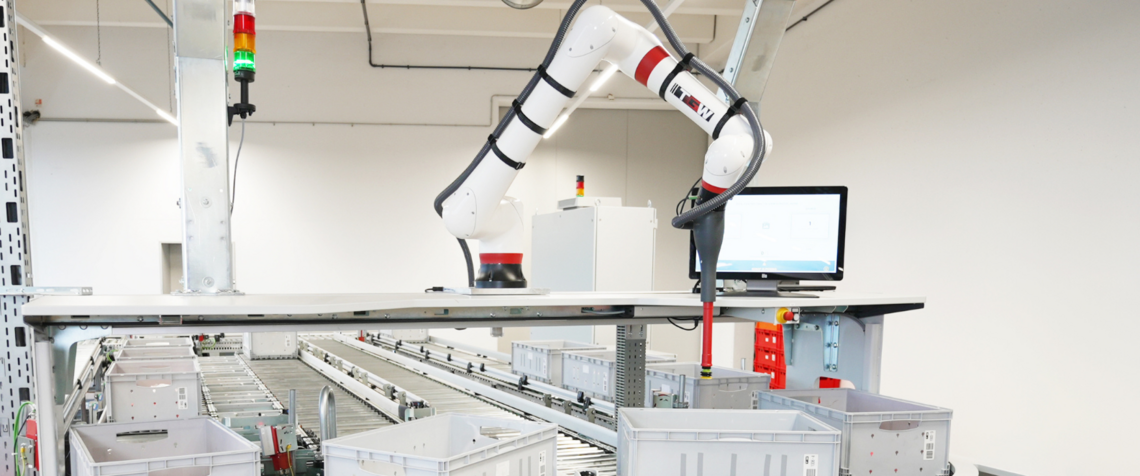
We built our RovoFlex around exactly this approach: a robotic picking arm designed to integrate with our FlashPick goods-to-person system, with the flexibility to switch between automated and manual picking modes for continuous operations. Facilities can also start with a smaller fleet of RovoFlexs and expand as order volume and business needs grow, due to its modularity and FlashPick integration simplicity.
The Questions That Separate Proven Vendors in Retail Logistics
The right vendor evaluation works more as a conversation about whether the system has actually performed in operations like the buyer's than as a product comparison.
The questions that matter carry weight in retail logistics and every adjacent vertical: What is your average throughput in a live deployment with a similar SKU profile? What does failure recovery look like in production, and how do you log it? Can we run emulation before go-live? Do you have documented deployments in grocery logistics or consumer goods logistics specifically? What does your integration process with our existing warehouse management system look like, and who owns that work? A vendor with real results behind them answers all of those questions with specifics.
The Operation Is the Starting Point
Evaluating a robotic picking system is a design question, and the answer depends on how a system fits into a specific operation rather than how it performs on a vendor's floor. Our solution design process starts with the operation itself, the order profiles, the SKU diversity, the peak patterns, and the integration requirements, and builds from there. RovoFlex and FlashPick form the foundation of our robotic picking approach. We would like to join that conversation for operations in the evaluation stage. It's possible.
![[Translate to North America:] robotic picking trends warehouse robots](/fileadmin/_processed_/c/a/csm_Robotic_Picking_Trends_Header_f2dd3889b6.png)