
Skip to main navigation Skip to main content Skip to page footer
Do you have questions about our products and services?
Our team will be happy to help you. You can reach us at
Blog Post

Grocery logistics under pressure: How warehouse automation protects margins and growth

Rising cost pressure, volatile demand and increasing operational complexity are forcing companies to rethink how their supply chains perform end to end.

From fresh and frozen handling to omnichannel fulfillment, logistics excellence has moved from an operational topic to a strategic growth lever.

Why supply chain performance has become a strategic priority

Margins remain structurally low while expectations continue to rise. Consumers demand availability, freshness and convenience, while labor shortages and inflation push operating costs upward.

At the same time, retailers face:

  • growing private-label assortments with higher SKU complexity
  • stronger demand for ready-to-eat and health-focused products
  • accelerating egrocery volumes alongside traditional store supply
  • increasing pressure on warehouse operations and staffing
     

Without structural improvements across logistics and fulfillment, these dynamics directly impact service levels and profitability.

Automation as the backbone of modern food logistics

Leading retailers and food companies are investing in advanced automation to stabilize operations and regain control.

Grocery automation supports:

  • consistent throughput and predictable performance
  • enable teams to focus on higher-value tasks
  • precise inventory management across ambient, chilled and frozen areas
  • scalable fulfillment for stores and online channels
     

In today’s environment, automation is not only about speed or cost. It is about reliability, transparency and long-term resilience.

Omnichannel growth changes warehouse operations

eCommerce growth and convenience-driven shopping have transformed fulfillment requirements. Higher order frequency, smaller order sizes and tighter delivery windows increase complexity across the supply chain.

Successful companies align:

  • store replenishment and online fulfillment processes
  • centralized and decentralized logistics models
  • automation, software and operational design
     

This integrated approach allows them to scale efficiently while maintaining service quality.

Managing freshness and temperature-sensitive products at scale

Fresh and chilled categories are critical growth drivers, but they demand excellence in execution.

High-performing cold chain logistics relies on:

  • automated, temperature-controlled storage and transport
  • minimal handling to protect product quality
  • synchronized replenishment to reduce waste and shrink
     

Well-designed warehouse systems help safeguard freshness while keeping energy consumption and operating costs under control.

What differentiates future-ready leaders

Across regions and formats, resilient organizations share common traits:

  • logistics is treated as a strategic capability, not a cost center
  • technology investments are modular and scalable
  • warehouse operations are designed for flexibility and change
  • decisions support long-term growth, not short-term fixes
     

They build systems that adapt as markets evolve.

Future trends in grocery retail: Insights from leading studies

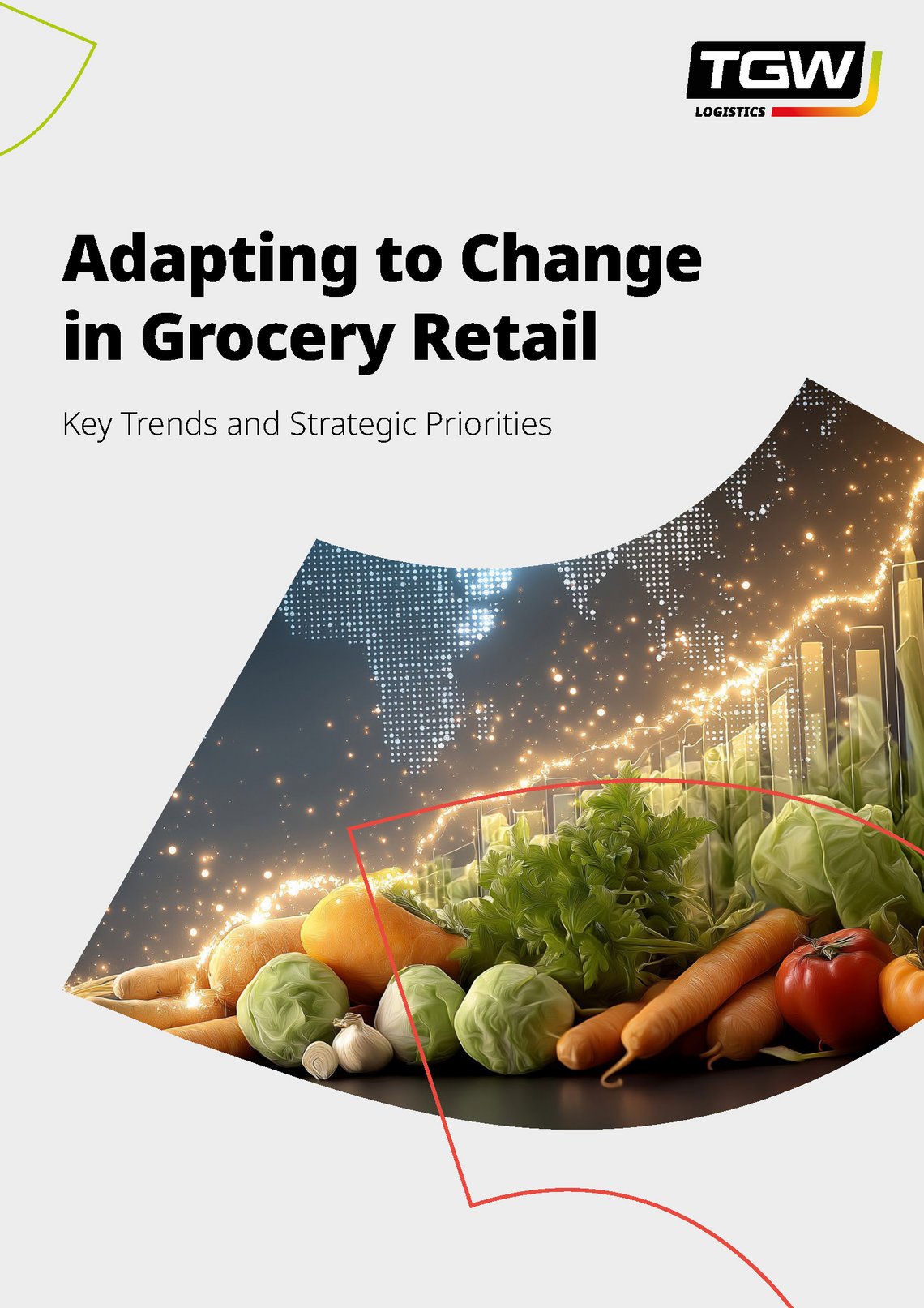
To help executives navigate these changes, TGW Logistics consolidated insights from three leading research studies into a single, decision-ready grocery trend paper. It highlights what matters now and where leaders should focus next to improve resilience, optimize operations, and drive profitable growth.

Download the TGW Logistics Grocery Trend Paper here for free:
Download

Bringing it all together: TGW Grocery Logistics

At TGW Logistics, we help grocery turn complexity into competitive advantage.
Our solutions combine intelligent warehouse automation, advanced software, and operational expertise to create supply chains that are efficient, resilient, and scalable.

With our support, grocery leaders can meet growing consumer expectations, protect margins, and focus their teams on value-adding activities — because lasting success is built in the warehouse, not just on the shelf.

Michael Schedlbauer is VP of Business Development for Grocery at TGW Logistics, with decades of global experience in automation and supply chain optimization.

Interested in collaborating or learning more?

Get in touch

TGW Logistics is a foundation-owned company headquartered in Austria and a global leader in warehouse automation and warehouse logistics. As a trusted systems integrator with more than 50 years of experience, we deliver end-to-end services: designing, implementing, and maintaining fulfillment centers powered by mechatronics, robotics, and advanced software solutions. With over 4,600 employees spanning Europe, Asia, and North America, we combine expertise, innovation, and a customer-centric dedication to help keep your business growing. With TGW Logistics, it's possible to transform your warehouse logistics into a competitive advantage.