

Minimizing Warehouse Fire Risk with Advanced Automated Storage and Retrieval System
Key Takeaways:
- Storage areas account for 37% of warehouse fires but 69% of the property damage, so the storage method a facility chooses carries most of the fire risk.
- Busbar-powered shuttle systems eliminate the decentralized lithium-ion batteries and charging areas that battery-powered AMR and AGV robots introduce into a building.
- A distributed load-carrier layout lowers combustible concentration in any single block and gives sprinklers and fire detection room to reach the goods.
- Segmented shuttle architecture limits the spread of fire and keeps fulfillment running when one area goes down.
US fire departments respond to roughly 1,544 warehouse structure fires each year, and the storage areas where goods sit account for a minority of those fires but the majority of the property damage. A facility decides how much of that risk it carries by the material handling choices it makes up front. Certain automated storage and retrieval systems can determine where the fire load is located and how easily crews and fixed systems can reach a fire.
A warehouse fire creates a continuity problem, and the damage extends past property loss. It damages goods and halts fulfillment, turning downtime into the cost that hurts an operations lead most. The property loss is only the visible part of the bill. Two design variables drive most of the fire risk: the density of stored goods and the way the machines draw their power. TGW’s Stingray shuttle technology takes a different approach to both.
Where Fire Risk Concentrates in an Automated Storage and Retrieval System
Storage technology determines where the fire load is located and how far a fire spreads before responders can reach it.
Two variables carry most of the risk inside an automated storage and retrieval system:
- Density of stored goods: a single compact block or goods distributed across racking.
- Power source for the machines: many onboard lithium-ion batteries or a fixed supply.
The storage-origin pattern is clearly evident in the warehouse structure fires data. Storage areas account for 37% of warehouse fires but 69% of the direct property damage, so the choice of storage method carries most of the loss potential rather than a marginal share.
Those two variables serve as the lens for comparing a busbar-powered shuttle system with battery-driven mobile robots. Both variables grow with the size of the operation across consumer goods logistics, where high-volume distribution centers run large fleets of automation around the clock.
A Distributed Layout Spreads the Fire Load and Opens Firefighting Access
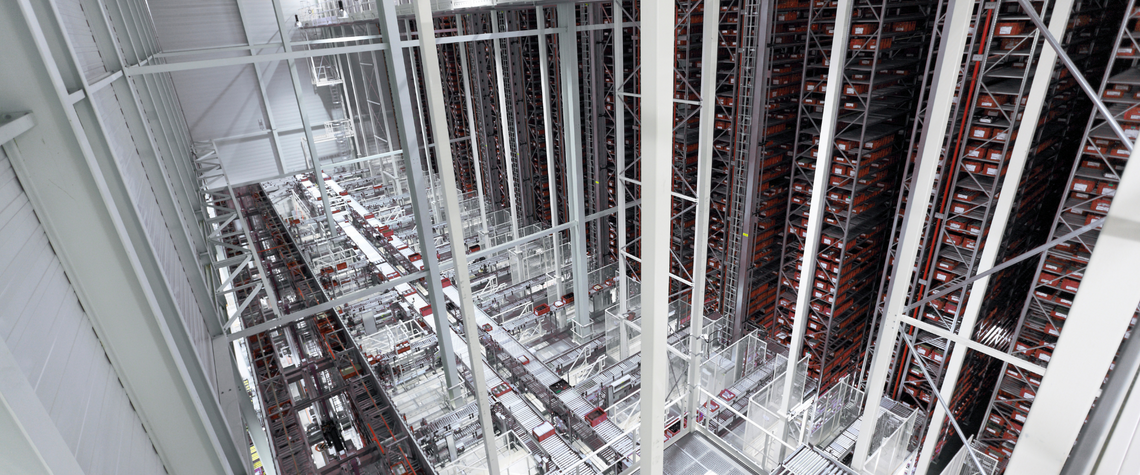
TGW’s Stingray shuttle technology distributes load carriers across individual levels within racking aisles, rather than concentrating thousands of containers in a single compact storage cube. Each shuttle serves defined areas of the system. Spreading goods across the aisles lowers the concentration of combustible material in any single block, which reduces the likelihood of fire spreading through the entire storage volume of the automated storage and retrieval system.
Reach is the practical difference. A compact cube can hide the seat of a fire behind thousands of containers, while a distributed layout keeps goods within range of fixed suppression and gives responders defined paths into the racking. The defined access areas between shuttle aisles and levels give fire protection systems room to work, beyond their use for inspection and maintenance. Integrated smoke extraction pulls heat and combustion products away before they build up, which supports both detection and safe access.
Busbar Power vs. Battery Robots in Consumer Goods Logistics
AMR and AGV robots each carry a battery and require regular charging, which requires installing a large number of lithium-ion batteries and dedicated charging areas inside the building. The power source is the less obvious of the two variables. Racking height and commodity type get attention in fire planning, while the decision to run hundreds of battery-powered robots often rides on an automation choice made for throughput. That decision sets the lithium-ion fire load that an automated storage and retrieval system carries for years.
A lithium-ion fire behaves differently from an ordinary warehouse fire. Cells in thermal runaway release flammable and toxic gases, and a pack that appears extinguished can reignite days or weeks later, complicating both suppression and re-entry. Mobility adds a further hazard specific to battery robots. A robot whose pack ignites while it is still moving can carry the fire across the floor before fire damage brings it to a stop, seeding ignition in new areas along its path. A fixed rack fire stays where it starts, while a mobile ignition source travels toward other goods and machines before it halts.
NFPA has flagged the broader trend, noting that warehouses increasingly house mobile lithium-ion robots that retrieve and move goods, often in buildings never designed to accommodate that hazard. Buildings put up for pallet storage decades ago now hold fleets of charging robots, a hazard their sprinkler and compartmentation design never anticipated.
TGW’s Stingray shuttle systems draw a continuous power supply through busbars built into the racking structure. The shuttles carry no large onboard batteries, and the facility needs no charging areas for hundreds of robots. That approach removes a whole category of decentralized battery storage and charging cycles. It reduces the lithium-ion fire load built into the system and keeps the remaining machines on fixed guideways rather than sending powered batteries roaming the floor. A simpler electrical setup stays behind.
Consumer goods logistics adds another layer, since much of the volume moves through chilled and deep-freeze zones. Stingray shuttles operate down to -22°F, so the same distributed, busbar-powered layout carries into cold storage without adding a battery fleet to an environment where detection and suppression already work harder.
No technology completely prevents fire, but busbar power provides a design advantage for risk minimization. In consumer goods logistics, where operations often deploy large mobile robot fleets to hit order volumes, the battery count climbs and the fire load climbs with it.
NFPA 855 governs stationary energy storage systems and requires a hazard mitigation analysis that evaluates failure modes such as thermal runaway propagation and toxic gas release. NFPA 13 excludes lithium-ion batteries from its sprinkler-design scope, leaving battery-heavy layouts with a hazard that standard sprinkler design does not fully address. A layout that designs out large onboard battery storage reduces the surface area that those requirements must cover.
Segmented Architecture Keeps Fulfillment Running
We build our shuttle systems on redundant, segmented architectures. Other areas keep operating when one area fails. That segmentation does two jobs at once for an operations lead: it limits how far a problem spreads and keeps fulfillment moving rather than halting the whole system. The same segmentation that supports availability also supports controlled damage limitation in a fire scenario.
Continuity matters because a warehouse fire rarely stays a property problem. Fulfillment stops while orders back up, and recovery time becomes the metric that operations leaders are held accountable for. Redundant design lets a facility isolate an affected area and keep the rest of the system filling orders while crews contain the incident.
Fire Protection Works as a System
Storage technology is one factor in the fire risk of an automated storage and retrieval system, working alongside several others.
The full picture includes:
- Building design
- Sprinkler and suppression systems
- Early detection
- Storage area segmentation
- Emergency planning
Fixed suppression, water supply, and alarm design each follow their own NFPA standards, and storage geometry influences how well those systems perform. A Stingray shuttle system's design advantages support these measures without replacing them. We treat fire protection as part of every application.
Off-hours sharpen the case for detection. Fires between midnight and 6 a.m. cause 40% of direct property damage from just 18% of warehouse fires, underscoring the importance of early detection in facilities that run lights-out. Automated facilities that run through the night rely on detection and suppression rather than on a nearby crew noticing smoke.
Design a Lower-Risk Automated Storage and Retrieval System
We design material handling systems that account for fire risk as a first principle, not a future retrofit. A busbar-powered shuttle layout reduces the fire load, distributes goods to improve suppression reach, and keeps fulfillment running with a segmented architecture. Chat with a TGW Logistics expert about shuttle-based ASRS and fire protection.
TGW Logistics is a foundation-owned enterprise headquartered in Austria and a global leader in warehouse automation and warehouse logistics. As a trusted systems integrator with more than 50 years of experience, we provide end-to-end services: designing, implementing, and maintaining fulfillment centers powered by mechatronics, robotics, and advanced software solutions.
With over 4,600 employees across Europe, Asia, and North America, we combine expertise, innovation, and a customer-centric dedication to help keep your business growing. With TGW Logistics, it's possible to transform your warehouse logistics into a competitive advantage.