
Order fulfillment has reached an inflection point, and traditional picking methods can no longer keep pace with rising service expectations. Warehouse leaders evaluating warehouse automation increasingly recognize that workers cannot continue spending the majority of a shift walking between storage locations. Studies of manual operations consistently show pickers logging miles per shift, with travel consuming as much as 60 to 70 percent of available labor hours. Goods-to-person automation flips that dynamic, sending product to a stationary operator instead of sending the operator to the product.
The macro pressures driving this shift are familiar to every operations leader: persistent labor scarcity, expanding SKU counts, and customer demands for next-day or same-day delivery in retail logistics, grocery logistics, and fashion logistics. Selecting the right system is not a matter of buying the fastest available technology. It depends on order profile, SKU dimensions, growth trajectory, and the realities of the building itself.
Person to Goods Picking and Its Operational Ceiling
Manual picking remains the default in warehouses where capital budgets are tight or product profiles defy conveyance. Workers move through aisles with carts, voice headsets, or RF scanners, retrieving items based on a pick list. The model demands almost no upfront infrastructure investment and accommodates virtually any product shape.
Those advantages come with a steep operational cost. Warehousing carries injury and illness rates well above the national average for private industry, with manual material handling cited as a leading contributor according to NIOSH research. Throughput stays low, error rates climb during peak weeks, and turnover compounds the cost of every new hire trained. Goods-to-person automation removes that travel burden entirely.
FlashPick Shuttle Technology Built for Fashion Logistics
TGW Logistics designed FlashPick as a modular shuttle-based system anchored by the Stingray shuttle and PickCenter One workstation. The system retrieves totes from dense storage, sequences them intelligently, and delivers each item to the operator in the exact order required for the shipping carton. That sequencing eliminates the double-touch handling that slows older goods-to-person installations.
Throughput climbs into the range required by fashion logistics operators who absorb 10x volume spikes during seasonal peaks, and the workstation geometry reduces reaching, twisting, and lifting that drive workforce attrition.
Trade-Offs and Fit
FlashPick performs best when SKUs fit standardized totes and cartons, and the capital investment exceeds what a small operation can absorb. Companies handling consistent product dimensions and high daily volume see the strongest payback, and the system scales as throughput grows without forcing a redesign of the broader fulfillment process. The FlashPick footprint also supports both discrete and batch picking, which matters as warehouse worker safety and order profiles shift with seasonal demand.
LivePick Mobile Robotics for Scalable Operations
LivePick takes a different architectural approach, using autonomous mobile robots to ferry totes from storage zones to fixed picking stations. The deployment timeline is significantly shorter than that of fixed-infrastructure shuttle systems, which appeals to operators working under lease constraints or under rapid growth pressure. Adding throughput capacity later means adding more robots, not pouring more concrete.
That flexibility makes LivePick especially well-suited to ecommerce operations that need to react quickly to changing SKU assortments and shifting order volumes.
Trade-Offs and Fit
Performance density, measured in totes per hour per square foot, falls short of what a fully built FlashPick installation delivers. LivePick can achieve high throughput, but it requires more floor space to do so. The primary building constraint is ceiling height: LivePick supports a maximum of roughly 40 feet, while shuttle-based systems can take advantage of taller structures.
For operations weighing deployment speed against peak capacity, the LivePick versus FlashPick comparison clarifies which profile fits which business model. The question is rarely which technology is better in the abstract. It is the technology that matches the volume curve and capital posture of the specific operation.
Shelf to Person Robotics as a Low-Investment Entry
A related category sometimes confused with mobile-robot goods-to-person is shelf to person automation, where robots lift entire shelving units and carry them to operators. The capital threshold is lower than for shuttle-based systems, and deployment moves quickly. Shelf to person works particularly well for facilities that run heavy batch picking or fulfill many small orders simultaneously.
The constraints matter, though. Throughput per station remains modest, and operators must carefully plan SKU placement so that a single popular item does not bottleneck the entire fleet by occupying a single rack. Spreading fast-movers across multiple shelves protects flow. Operations weighing this category against shuttle- or AMR-based systems should map order profiles against throughput ceilings before committing.
High-Density Cube Storage Compared to Shuttle Systems
Cube storage systems pack inventory into a grid of stacked bins with no aisles, and robots travel across the top of the grid to retrieve them. The density is unmatched, making cube storage attractive for buildings where the horizontal footprint is constrained or expensive.
The compromise sits in retrieval latency. Bins buried deep in the grid require digging, during which robots move the upper bins aside to reach the target. Cube storage also requires a stable ABC velocity curve and long visibility into incoming orders so the system can pre-position totes effectively. It cannot handle urgent or expedited orders well, and it is limited to a single storage tote size. A shuttle system like FlashPick handles A-velocity items with lower latency and accommodates multiple tote sizes, including totes for bulky items up to 800 x 600 mm.
Matching Goods-to-Person Strategy to Your Operation
Throughput, density, and flexibility represent three competing priorities, and no single architecture optimizes all three. Shuttle systems lead in throughput and ergonomics. Cube systems lead in density. AMR-based systems lead in deployment speed and scalability. The decision comes down to which priority matters most given the operation's order profile, SKU velocity, and growth trajectory. TGW Logistics partners with operations leaders to evaluate those trade-offs and design the system that fits.
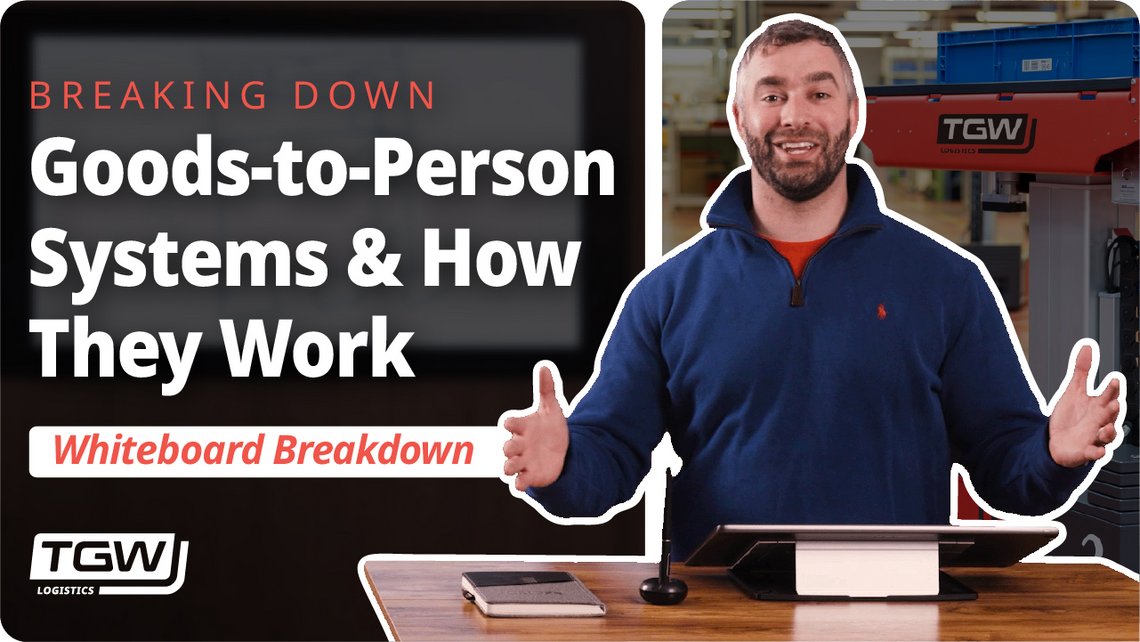
Recommended Watch
Curious to know more about different goods-to-person automation systems? Click to watch this Whiteboard Session to hear Dexter Weber break down the differences in mobile robotic GTP systems and how to think about what technologies may make sense for your operation.
Goods-to-Person in Grocery Logistics and Retail Logistics
Mango: Global Fashion Fulfillment
Mango operates one of the most visible examples of goods-to-person automation serving global retail logistics. The Spanish fashion retailer consolidated operations into a centralized distribution center in Lliça d'Amunt, partnering with TGW Logistics to deploy shuttle storage, cross-belt sorters processing up to 30,000 items per hour, and high-performance goods-to-person picking stations for prioritized and slow-moving SKUs. The facility now fulfills orders for more than 2,200 stores across over 100 countries, with an automated mini-load warehouse consolidating cartons for a linear sorter that loads 5,800 cartons per hour into outbound trucks.
Frisco: E-Grocery Fulfillment at Scale
Grocery logistics presents different demands but rewards similar architecture. Frisco, one of Poland's leading online grocery retailers and part of the Eurocash Group, partnered with TGW Logistics to automate a 118,400-square-foot fulfillment center outside Warsaw spanning four discrete temperature zones: ambient, produce, refrigerated, and freezer. The TGW Logistics design centers on a shuttle warehouse with 36,000 storage locations capable of storing and retrieving more than 4,000 items per hour, feeding 12 ergonomic PickCenter One workstations where operators pick orders in sequence. A palletizing robot loads finished totes into roll containers for last-mile delivery. The result quadrupled Frisco's daily order capacity, reduced lead times enough to offer same-day delivery of fresh groceries, and cut food waste by moving product through the facility faster. The facility was also designed for seamless expansion as Frisco's volume grows.
Designing a Future-Ready Roadmap with TGW Logistics
Automation rewires the warehouse from a labor-bound cost center into a predictable engine for growth, and the operations leaders who move first build a structural advantage competitors cannot easily close. The work begins with honest analysis of order profile, SKU velocity, and growth projections, and it ends with a system designed to evolve as the business changes.
TGW Logistics partners with operations leaders to navigate the trade-offs between speed, density, and flexibility, designing fulfillment systems that perform on day one and remain relevant a decade later. Operations leaders ready to pressure-test their next phase of automation should contact TGW Logistics to start the conversation. It's possible.
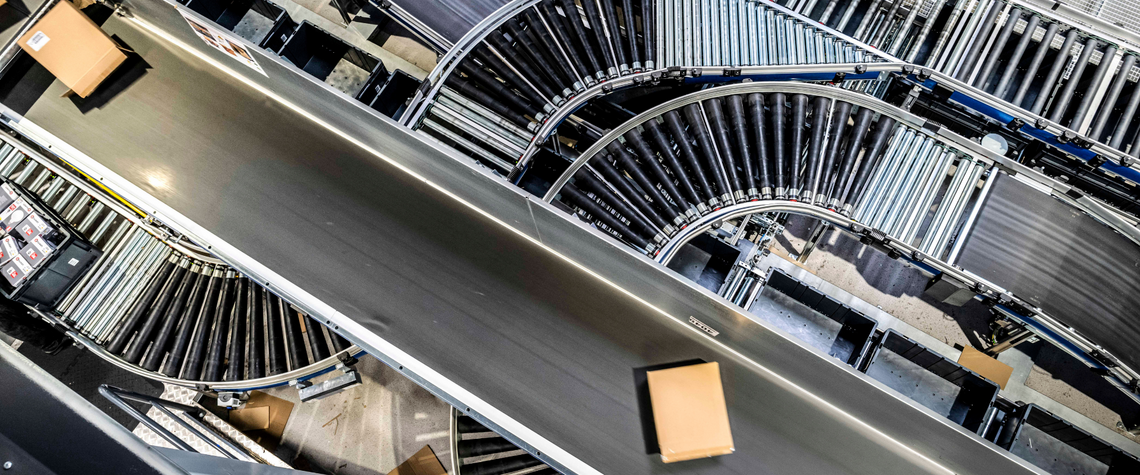
![[Translate to UK:] Shuttle systems are a key technology component used within many material handling GTP systems to facilitate the process of bringing items to the picker.](/fileadmin/_processed_/6/c/csm_DIYhome_improvement_Blog_Header__9769adb897.png)
TGW Logistics is a foundation-owned enterprise headquartered in Austria and a global leader in warehouse automation and warehouse logistics. As a trusted systems integrator with more than 50 years of experience, we provide end-to-end services: designing, implementing, and maintaining fulfillment centers powered by mechatronics, robotics, and advanced software solutions.
With over 5,000 employees across Europe, Asia, and North America, we combine expertise, innovation, and a customer-centric dedication to help keep your business growing. With TGW Logistics, it's possible to transform your warehouse logistics into a competitive advantage.