
Key Takeaways
- Throughput figures mean little without context: load size, aisle configuration, and time window all shape real output.
- Storage depth should match the SKU profile and carton mix; weight capacity is determined by the load-handling device.
- Cold chain and grocery logistics operations require sub-zero engineering, verified by live deployment data rather than literature.
- Maintenance access design decides whether a repair stops one level or a whole aisle.
- Redundancy is specified separately at the lift, conveyor, and software layers, and is costly to add later.
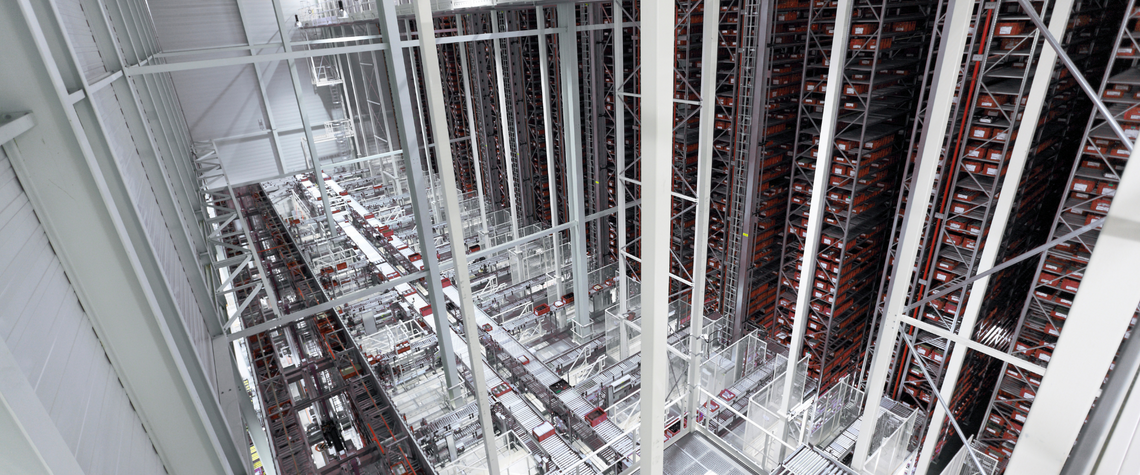
A shuttle system is the retrieval engine at the center of many goods-to-person operations. It moves horizontally and sometimes vertically through racking to deposit and retrieve totes or cartons, delivering them directly to stationary pick workstations and removing the manual travel that slows conventional picking. Shuttles reach high-bay storage levels that workers cannot, so goods are stored far more densely, and a facility uses its cubic footprint more fully. We design material handling solutions around that density advantage every day.
Most evaluations focus on throughput numbers and stop there. The specification factors that actually determine long-term performance, namely SKU profile alignment, load configuration, temperature compatibility, maintenance access, and redundancy architecture, unfortunately often get underspecified during procurement.
What Throughput Numbers Actually Mean for Industrial Logistics
Vendors publish throughput figures as a primary performance claim, and the numbers vary widely between competing products. Those figures mean something in a buying decision only with context attached: throughput under what conditions, with what load sizes, over what time window, and in a configuration that matches the operation being evaluated.
Our Stingray shuttle system sustains more than 1,500 load carriers per hour per aisle, a figure we hold as the world's most powerful shuttle performance rather than an industry baseline. That number reflects defined conditions, including a specific tote size, aisle configuration, and sustained operational window.
Buyers should ask any vendor what its published figure actually measures, including whether it counts bidirectional movement or a single direction, and request that the throughput be modeled against real order history rather than a uniform test load. A system that hits its peak on a clean test profile can perform very differently against a mixed-size, real-world order mix in industrial logistics environments. The Material Handling Institute documents the fundamentals of automated storage for buyers, helping them build that baseline understanding. The fastest system in an evaluation sustains the highest throughput under the buyer's own conditions, not the highest number on a spec sheet.
How a Shuttle System Matches SKU Profile and Load Configuration in Grocery Logistics
Shuttle systems are not one-size configurations. Load dimensions, weights, and variety determine which configuration performs efficiently, and a poor match shows up later as throughput gaps, equipment wear, or storage density problems that were invisible during procurement.
Standard configurations handle items up to 31.5x23.5in without modification, which covers operations running primarily standard totes and cartons. Storage depth is where most density decisions get made. Single-deep racking gives every load carrier direct access, while double-deep and multi-deep configurations store load carriers behind one another to raise density, trading off some direct-access speed for cubic efficiency.
Operations with mixed carton or item sizes, which describes most grocery logistics and consumer goods environments, gain the most from multi-deep storage because it absorbs size variety without sacrificing density. A grocery operation spanning ambient dry goods, chilled produce, and frozen items rarely shares the uniform load profile of a pure industrial parts operation, so the configuration that suits one rarely transfers cleanly to the other.
Weight is a separate specification axis. The Stingray shuttle system handles load carriers up to 110 lbs, and that capacity comes from the load handling device selected for the system, not from storage depth. Row height inside an aisle matters too. Integrators should explain how they size each row to maximize storage space, since an operation running only a few oversized cartons may need just one or two taller rows rather than a uniform tall configuration throughout the rack.
Temperature Compatibility for Cold Chain and Grocery Logistics
Temperature gets treated as a checkbox in many evaluations, working in cold storage or not, when it is actually a detailed engineering question with meaningful variation between solutions.
Grocery logistics and cold chain operations running ambient and frozen zones need shuttles rated for sub-zero environments. Specifying an ambient-rated system and assuming cold compatibility adds risk that verified performance data should resolve. Our Stingray operates in temperatures as low as -22°F (-30°C), covering the full range of frozen storage in commercial cold chain operations.
That rating reflects engineering built for extreme cold from the start, with lubrication, materials, and electronics all specified for sustained sub-zero operation rather than adapted from an ambient design after the fact. The Global Cold Chain Alliance identifies flexibility and peak-condition throughput as the primary design challenges in automated cold storage and notes that understanding product-handling requirements before specifying automation is essential. The same discipline applies in fashion logistics operations, where seasonal peaks stress a system that looked adequate at average volume.
Maintenance Access Design for Fashion Logistics and Other High-Velocity Operations
Maintenance access is the factor most commonly underweighted in procurement evaluation, and one of the most consequential for uptime. How a system handles maintenance determines whether a repair shuts down one level, one aisle, or a larger portion of the operation—a difference that compounds sharply at high volume.
In a well-designed shuttle system, maintenance platforms and access doors stop activity only on the level being serviced, while shuttles in the rest of the aisle continue running. When a repair exceeds a defined time threshold, the software automatically reallocates the tote to hold throughput from unaffected levels.
That isolation is an engineering decision rather than a standard feature of every system, and it belongs in the specification criteria before a vendor is chosen. For fashion logistics operations and other high-velocity environments, where peak periods create dense, sustained demand, the gap between level isolation and full-aisle shutdown can separate a maintenance event measured in minutes from one measured in hours of lost production.
Redundancy Architecture
Redundancy applies across several layers of a shuttle system simultaneously, and each layer requires an independent specification because its failure modes differ.
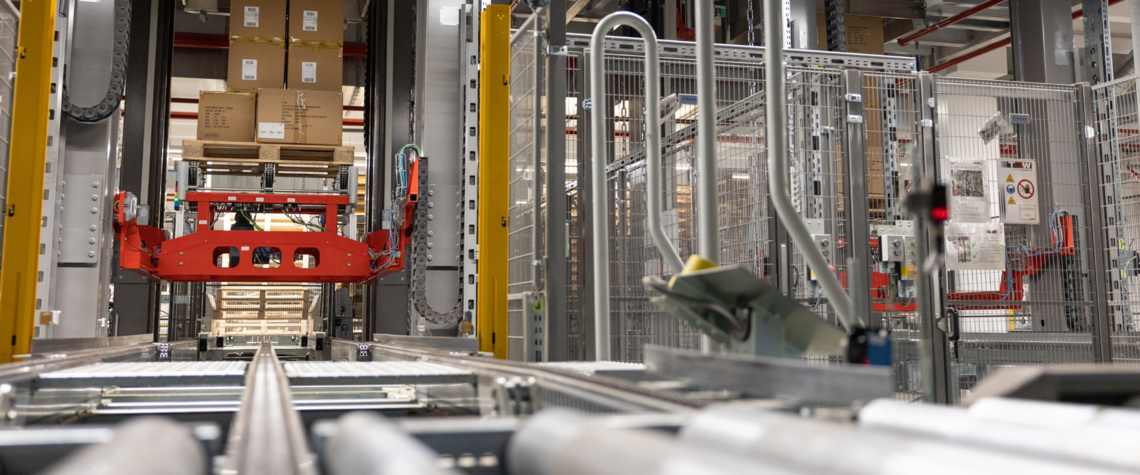
Aisles can carry two independent load-handling devices on each lift mast at the lift level. If one device fails, it parks itself at the top or bottom of the mast, while the second takes over all vertical movement without interrupting tote flow. That arrangement requires two devices per mast, a cost that is easy to cut in procurement and expensive to recover in operation.
Dual inbound and outbound conveyor lines connect each aisle to the wider material flow network at the conveyor level, and the alternate line takes over immediately when one goes offline while the load-handling devices reroute totes without stopping production. Single-conveyor configurations remove that failover entirely. Consider an aisle in a frozen temperature zone that loses a conveyor line during a peak grocery replenishment window: a dual-line design keeps totes moving, while a single-line design freezes the aisle until a technician arrives.
Self-healing intelligence operates at the software level, where systems like the Stingray run automatic health checks, detect positioning errors, and resolve them autonomously, cutting manual intervention by up to 90%. We cover the architecture in depth in our guide to redundant systems design. Each layer is a specification line item, confirmed during evaluation rather than assumed.
Specify for the Operation Running in Year Five
A shuttle system specified correctly for today's volume and SKU profile, but not for projected growth, turns into a replacement decision in three to five years that a configuration decision could have prevented. The right process starts with where the operation is going, not only where it stands.
Our solution design builds the specification from operational data, including current throughput, peak patterns, SKU profile, temperature requirements, and growth projections, before recommending a configuration. With our customers, we walk through the matching process in evaluating ASRS configurations for a specific SKU profile.
The specification phase is where TGW Logistics turns operational data into a system built to perform, and where we prove what is possible.
TGW Logistics is a foundation-owned enterprise headquartered in Austria and a global leader in warehouse automation and warehouse logistics. As a trusted systems integrator with more than 50 years of experience, we provide end-to-end services: designing, implementing, and maintaining fulfillment centers powered by mechatronics, robotics, and advanced software solutions.
With over 5,000 employees across Europe, Asia, and North America, we combine expertise, innovation, and a customer-centric dedication to help keep your business growing. With TGW Logistics, it's possible to transform your warehouse logistics into a competitive advantage.