

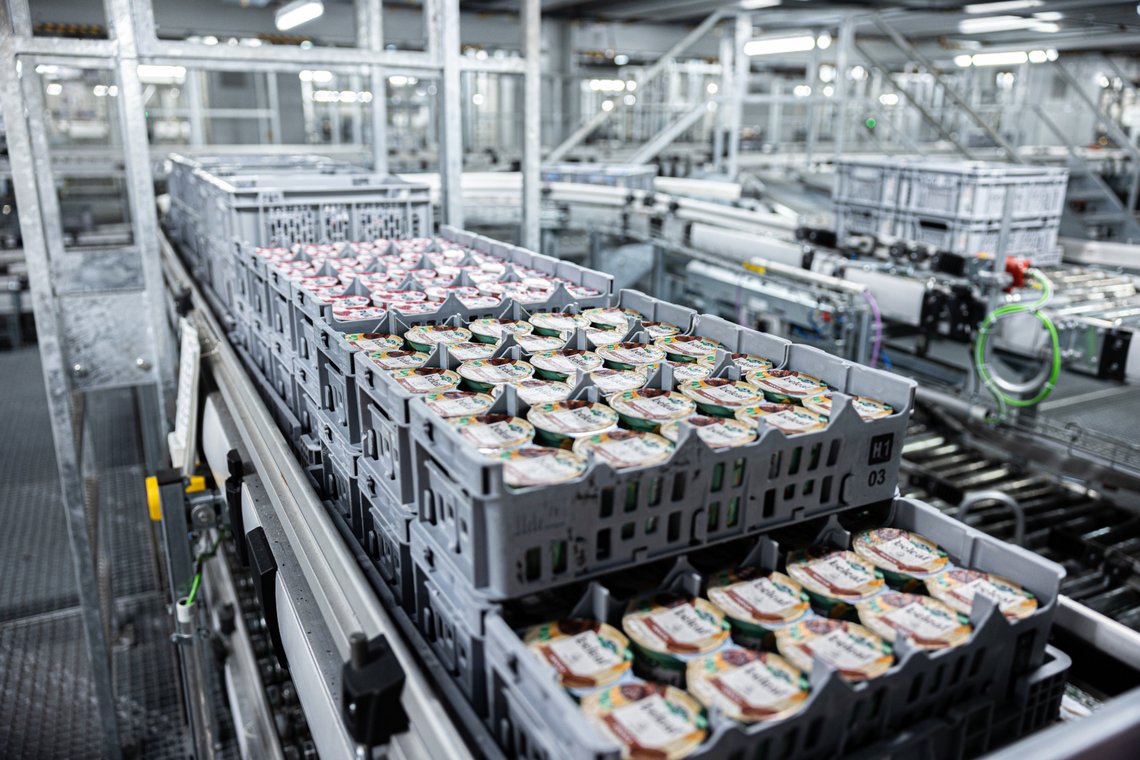
Grocery automation faces a fundamental SKU problem that traditional material handling environments usually do not: the same system and equipment that handles a uniform case of cereal must also safely transport a jumbo-sized bottle of olive oil, a perishable bag of frozen shrimp, and an unwieldy stretch-wrapped pack of paper towels. In an automated grocery warehouse, product variability can introduce friction at almost every stage of the process. Unlike in the world of general merchandising, where packaging is often designed with conveyability and storage in mind, most grocery items enter the system as-is, resulting in a wide variety of shapes, weights, and fragility concerns.
Because of this inherent and unavoidable variability, conveyor-based material handling systems built around inconsistent case sizes absorb the cost through higher error rates, slower throughput, and increased equipment complexity. Standardizing on trays addresses the foundational issue by establishing a single surface dimension and a single set of system parameters for your facility’s entire SKU range. With trays, automated grocery warehouses can reduce variability, simplify system design, decrease damage and spoilage rates, and overall establish more predictable performance.
Video Breakdown
Prefer to listen than read? Watch the video at right to hear Nathan Wolf of TGW North America explain the key insights from this blog. For more relevant videos, check out our "The Automation Conversation" playlist on YouTube.

How Trays Simplify Conveyor System Design
Designing a conveyor system that accommodates varying case sizes quickly becomes complicated in every decision. Not only does each layout curve require a wider tolerance than usual, but the gaps between items on the conveyor must accommodate the largest possible format. Additionally, the system's accumulation logic must be prepared for items that may tip over, spread out, rotate, or create uneven gaps. Failure to plan for this unpredictability leads to bottlenecks, product damage, and inconsistent throughput.
The simplest way to remove that conveyor variability is to implement a tray system. No matter what lies on top of the tray, the tray’s dimensions remain uniform. Automation system designers need only work with a single set of measurements to accommodate the facility’s full SKU range. This allows for tighter curves, smaller gaps, and more reliable start and stop windows. The ultimate result is a material handling system that runs more smoothly, more predictably, and faster than any designed around inconsistent case sizes. In high-throughput grocery environments with wide SKU catalogs, conveyor-level consistency is essential for system-wide predictability and peak performance.
Conveyor Systems Built for the Full Grocery SKU Catalog
A standard conveyor system in an automated grocery warehouse would exclude a large portion of typical grocery items, because small items can fall through rollers to be damaged or lost, bags can get caught in machinery, and liquids are unstable at the standard conveyance speed. Trays shift the conveyor focus from the item to the dimensionally consistent surface on which it travels. The system must be built to interact only with the tray, not with each individual product and its packaging.
Transitioning to a tray conveyor system directly affects what can be automated and which products must be handled manually. It enables a fuller adoption of automation by including items that would require a separate handling process or would be excluded from automation entirely in a standard conveyor environment. With trays, nearly the entire SKU catalog can move through the same system without special handling phases that slow down the entire process. Automated grocery warehouses that have been standardized with trays have a broader automation footprint and necessitate fewer carve-outs for difficult items, alleviating additional labor costs and operational complexity.
Maximizing ASRS Storage Density with Tray-Based Picking
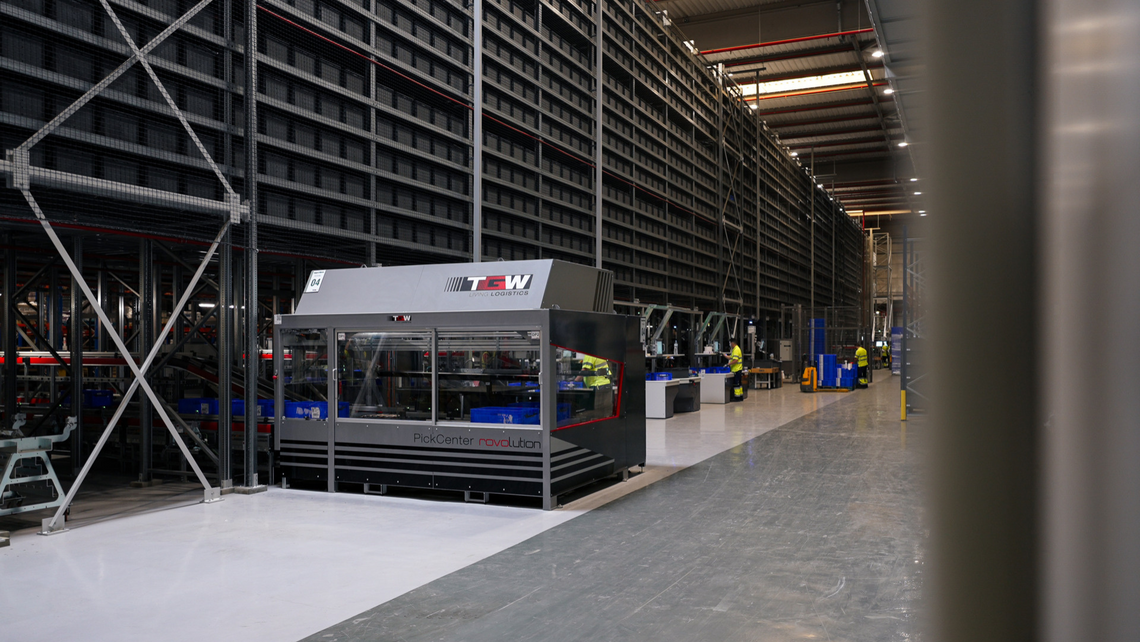
Tray-based picking fundamentally changes how storage capacity is utilized within an ASRS facility. In a conventional ASRS setup, each storage position is limited to one carton or unit. Trays break out of that one-to-one relationship by allowing multiple cartons or units to be stored in a single storage position. The result is maximized storage space and increased storage density without expanding the facility’s physical footprint. This upgrade is especially valuable to warehouses where space is at a premium and expansion is too costly.
The tray approach also enables more efficient retrieval and replenishment workflows. When an order calls for specific units, the system retrieves the correct tray, picks only the products required, and returns the remaining inventory to its original storage position. Because multiple items with different SKUs can be stored on the same tray, fewer retrieval cycles are required to fulfill orders, reducing travel times. At the same time, inventory remains organized, accessible, and easy to replenish without the need for manual resorting or re-slotting.
For an automated grocery warehouse managing a broad range of SKUs in a limited space, maximizing storage density provides a consequential operational advantage. With trays, rather than being a fixed constraint, storage capacity becomes a flexible asset.
Automated Tray Maintenance in an Automated Grocery Warehouse Environment
There’s a caveat to all of this, however: A tray-based system can only deliver all of its possible benefits if the trays are well-managed. In a grocery environment, this management will almost certainly include cleaning up spills, neutralizing contamination, and meeting sanitation requirements for handling food products.
TGW Logistics’ tray-based conveyor systems have built-in handling and management capabilities. Once a tray is emptied, it is transferred to a buffer area where it’s stacked and held until its next use without the need for manual collection or restacking. As for breakage and spills, high-tech camera systems identify contaminated trays and automatically route them to a designated cleaning area (known as a “hospital area”) instead of the buffer zone. There, warehouse staffers can clean them to the established standard before they reenter the system for reuse.
The automated re-routing saves time by separating unusable trays out of the active flow before a human touchpoint is required. In a high-throughput grocery facility, manually inspecting each tray after it’s emptied would be tedious and time-consuming, and could lead to missed spills.
The Tray as a Foundation for Grocery Automation
As grocery distribution centers grow and respond to industry demand and changes, turning to a tray-based conveyor system is an automation design decision that positively impacts system speed, SKU coverage, storage density, and sanitation management across the entire warehouse operation. Instead of reverse-engineering around the quirks of individual items and their packaging, the system creates a stable, consistent baseline to keep materials moving smoothly.
In grocery logistics, where SKU assortments are broad, temperature requirements vary, and throughput expectations are high, standardization has an outsized impact. Conveyability, storage, and cleanliness are all addressed in parallel by the same automation solution, rather than requiring separate strategies.
Ready to learn more about tray conveyor systems and how they can revolutionize your facility? Reach out to TGW Logistics today.


TGW Logistics is a foundation-owned enterprise headquartered in Austria and a global leader in warehouse automation and warehouse logistics. As a trusted systems integrator with more than 50 years of experience, we provide end-to-end services: designing, implementing, and maintaining fulfillment centers powered by mechatronics, robotics, and advanced software solutions.
With over 4,600 employees across Europe, Asia, and North America, we combine expertise, innovation, and a customer-centric dedication to help keep your business growing. With TGW Logistics, it's possible to transform your warehouse logistics into a competitive advantage.