

In modern industrial logistics, navigation is one of the most important differentiators in warehouse robots. Within the broader context of material handling, the way a mobile system understands, maps, and moves through a facility directly shapes reliability, flexibility, and long-term performance. For operations leaders evaluating automated guided vehicles and mobile robotics fleets, navigation architecture determines how systems behave under real production pressure.
Navigation is critical; it’s the foundation that determines whether automated guided vehicles and autonomous mobile robots can scale with operational growth or become constrained by their own infrastructure. In facilities where SKU counts expand, order profiles shift, and peak demand compresses timelines, navigation performance directly influences service levels.
Navigation Defines Performance in Warehouse Robots
The performance of warehouse robots depends on how precisely and consistently they navigate.
Guidance systems influence:
- Route stability and travel accuracy
- Scalability as fleets grow
- Downtime required for layout changes
- Long-term operational resilience
Navigation technology ultimately determines how flexible a solution is in a material handling environment.
In practical terms, a navigation decision made during system design can shape operational constraints for years. Fixed-path systems may deliver stability in predictable environments, but highly dynamic industrial logistics operations require guidance models that accommodate growth without major reconstruction.
As mobile robotics evolves, guidance systems are shifting from fixed physical infrastructure toward intelligent, software-defined navigation. This shift is reshaping industrial logistics facilities worldwide. According to industry research, adoption of advanced mobile robots in supply chains continues to rise as organizations seek flexibility and resilience in operations. External industry surveys also show sustained investment in warehouse automation technologies, reinforcing the importance of scalable navigation frameworks.
The Evolution of Navigation in Warehouse Robots
Early Navigation: Magnetic Tape and Inductive Wires
Traditional automated guided vehicles relied on magnetic strips or inductive wires embedded in the floor. These physical guides created rigid travel paths that vehicles could not deviate from without losing orientation. These systems offered predictability, but they also required permanent floor modifications. Any change in layout requires physical intervention, including downtime and construction. Expanding routes meant installing additional embedded guidance.
In long-established production environments with stable material flows, this approach remains viable. However, in fulfillment centers and distribution hubs where layouts evolve regularly, embedded guidance can limit responsiveness. Every route extension requires physical intervention, which introduces scheduling complexity and potential production interruption.
Modern Contour Navigation and Virtual Mapping
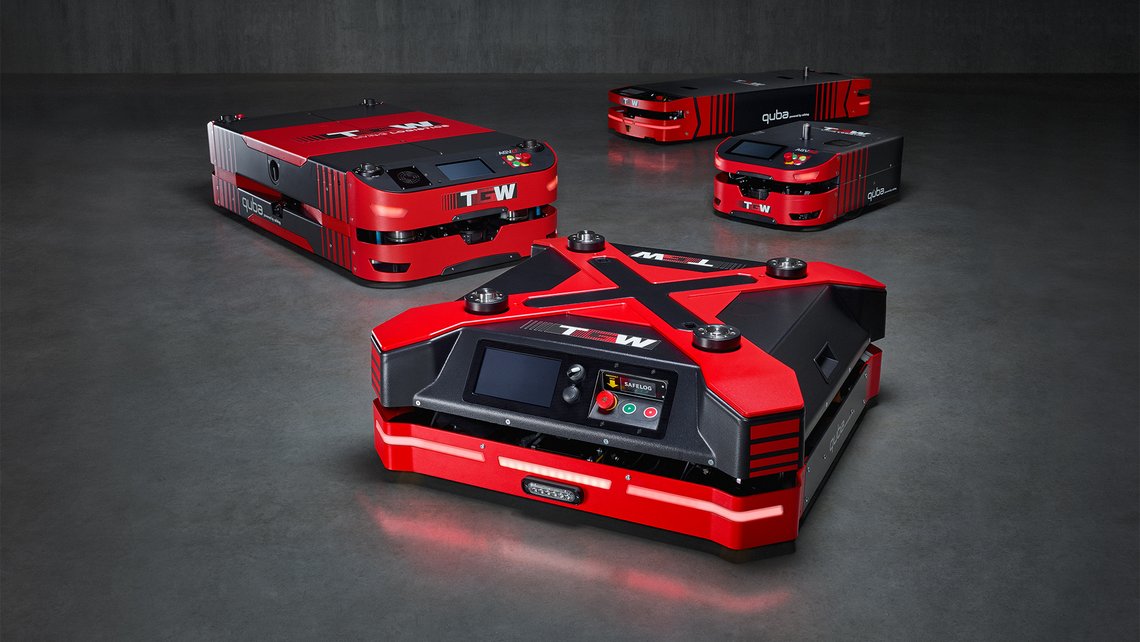
Most contemporary warehouse robots now rely on contour-based navigation supported by virtual facility maps. Robots scan their surroundings and create a digital representation of the facility stored within fleet management software.
This approach enables engineered paths without permanent floor constraints. Software-defined routing allows faster reconfiguration as workflows evolve. Many of these systems use methodologies that combine lidar, vision systems, and environmental data to build and continuously refine digital maps. Unlike fixed-path systems, virtual mapping allows operators to adjust routes, redefine zones, or integrate new process steps through software rather than construction.
Navigation operates similarly to advanced consumer robotics in concept, but scaled for industrial precision and durability. The result is greater agility across the facility while maintaining repeatable performance.
Precision Enhancements Through Hybrid Navigation
Even advanced contour systems benefit from supplementary positioning technologies to ensure high accuracy during critical operations, particularly in environments where small positional errors can cascade into downstream inefficiencies such as misaligned transfers, delayed cycle times, or increased mechanical wear. While virtual navigation provides flexibility, hybrid models introduce controlled precision where it matters most.
Reflective Markers and Fixed Reference Points
Three-sided reflective poles placed throughout a facility enhance positional accuracy. These reference markers improve reliability across the majority of travel operations and balance flexibility with industrial-grade precision
By adding these fixed reference points, facilities reduce cumulative drift and maintain consistent alignment across long travel distances. This approach supports high-volume industrial logistics environments where repeatability is essential for safe interactions between warehouse robots and stationary automation.
Targeted High-Accuracy Technologies
Certain zones require millimeter-level positioning, particularly at handover points or transfer stations. In these areas, systems may incorporate:
- Magnetic tape segments
- QR codes
- RFID tags
These targeted placements provide precise alignment without covering the entire floor. Hybrid navigation models blend software intelligence with minimal physical infrastructure, allowing industrial logistics facilities to preserve adaptability while protecting critical accuracy zones.
This layered strategy allows operators to maintain high flexibility across most travel routes while reinforcing accuracy where tolerances are tight. Instead of choosing between fully virtual or fully embedded guidance, many facilities implement blended architectures optimized for specific process requirements.
Emerging Navigation Technologies in Mobile Robotics
Navigation continues to advance beyond contour mapping toward adaptive and sensor-rich approaches.
Several technologies are shaping the next phase of warehouse robots development:
- Radar-based navigation for environments with variable lighting or dynamic obstructions
- Floor fingerprinting techniques that map microscopic surface variations
- Sensor fusion combining lidar, vision systems, and environmental data
- Self-correcting algorithms that improve over time
Radar-based navigation is being evaluated for facilities where dust, glare, or low-light conditions affect optical systems. Floor fingerprinting technologies aim to leverage unique surface characteristics as orientation anchors, potentially reducing reliance on additional infrastructure. Sensor fusion increases redundancy by blending multiple data inputs. If one sensor stream degrades, the others continue to support accurate positioning.
The longer-term direction points toward navigation systems that continuously refine their maps based on operational data. Over time, warehouse robots may become increasingly self-correcting, identifying route inefficiencies, congestion patterns, and environmental changes without manual recalibration.
Workforce Impact and Operational Flexibility
Mobile robotics deployments are designed to support workers by improving ergonomics and reducing repetitive transport tasks. In operations facing labor variability, flexible navigation reduces the burden on teams during peak periods. Robots can be reassigned dynamically to support replenishment, order picking, or buffer management as conditions shift.
When robots can adapt to changing workflows without extensive reprogramming, operations teams gain practical flexibility. Layout adjustments, peak season changes, and phased expansions become more manageable.
Clear digital maps and software-defined routes also improve transparency for supervisors. Fleet management platforms can visualize traffic flows, optimize travel paths, and coordinate multi-robot interactions. As a result, navigation is not isolated from broader system orchestration. It becomes an integrated component of the material handling strategy.
What the Future Holds for Warehouse Robots
Navigation systems are steadily moving toward higher levels of autonomy and environmental awareness. Hybrid guidance models will likely persist, combining virtual mapping with selective physical references. Software-driven navigation will continue to expand flexibility in material handling operations.
For operations leaders evaluating mobile robotics investments, the evaluation criteria should extend beyond speed and payload capacity. Key considerations include mapping methodology, scalability of fleet control software, sensor redundancy, and the effort required to modify routes. These factors define how adaptable warehouse robots will be over the next decade.
Engineered Navigation Drives Measurable Performance.
Navigation architecture shapes how reliably your automation performs, how flexibly it adapts, and how confidently you can scale in demanding industrial logistics environments. At TGW Logistics, mobile robotics guidance is engineered as part of a complete material handling strategy, grounded in data, validated through real-world performance, and designed for long-term operational stability.
When you partner with TGW Logistics, you gain a navigation framework built to support growth, resilience, and measurable results across your facility. Connect with our automation experts to evaluate your navigation strategy and explore how intelligent mobile robotics can strengthen your operation.
![[Translate to North America:] robotic picking trends warehouse robots](/fileadmin/_processed_/c/a/csm_Robotic_Picking_Trends_Header_f2dd3889b6.png)
TGW Logistics is a foundation-owned enterprise headquartered in Austria and a global leader in warehouse automation and warehouse logistics. As a trusted systems integrator with more than 50 years of experience, we provide end-to-end services: designing, implementing, and maintaining fulfillment centers powered by mechatronics, robotics, and advanced software solutions.
With over 4,600 employees across Europe, Asia, and North America, we combine expertise, innovation, and a customer-centric dedication to help keep your business growing. With TGW Logistics, it's possible to transform your warehouse logistics into a competitive advantage.